memory • science • cognitive
The Science of Memory: How Recall Really Works
Turn cognitive psychology into a practical retention system
Why understanding memory matters
If you want to learn efficiently, you need to understand the constraints and strengths of your brain. Cognitive psychology shows that small tweaks to encoding, consolidation, and retrieval dramatically improve retention—if your tools align with how memory works.

Encoding, storage, retrieval (with visuals)
Memory has three stages. Design your learning flow so each stage gets what it needs: deep processing during encoding, rest and spacing during storage, and deliberate retrieval practice.
- Shallow encoding (skimming) creates fragile traces—elaborate instead.
- Sleep, spaced reviews, and varied contexts stabilise storage.
- Active recall strengthens retrieval pathways and speeds access.
Working memory & cognitive load
Working memory is a small whiteboard. When multitasking floods it, nothing sticks. Create distraction-free sessions and chunk problems so you respect the limits of your mental workspace.

Forgetting curves and spacing
Hermann Ebbinghaus showed how quickly information decays. Each successful recall flattens the curve. Space reviews around the moments you are about to forget.
- Review new material the next day, then 3d, 7d, 30d.
- Automate resurfacing reminders so nothing slips through.
- Keep cards short so sessions stay under five minutes.

Context & state dependence
Memories stick to the context where they were formed. Vary your study locations, moods, and modalities so recall becomes robust. Recreate the conditions where you will need the knowledge.
Elaborative encoding techniques
Link new ideas to concepts, stories, and metaphors you already own. The richer the network, the easier the recall.
- Ask "why" three times to uncover mechanisms.
- Create metaphors or visual diagrams for abstract ideas.
- Teach the concept to someone else in plain language.
Retrieval practice as the engine
Every recall attempt is a workout for your neural pathways. Low-stakes quizzes, flashcards, and self explanations beat rereading.
- Turn meeting notes into three self-questions.
- Mix topics (interleaving) to avoid autopilot.
- Pair retrieval with immediate feedback for best results.

Designing a memory-friendly second brain
A memory-aware second brain resurfaces ideas at the right time, shows how concepts connect, and gives you retrieval prompts.
- Schedule automatic resurfacing for key notes.
- Tag by projects, principles, and people to create multiple paths.
- Embed questions in notes so review triggers active recall.

How Vedaric embeds memory science
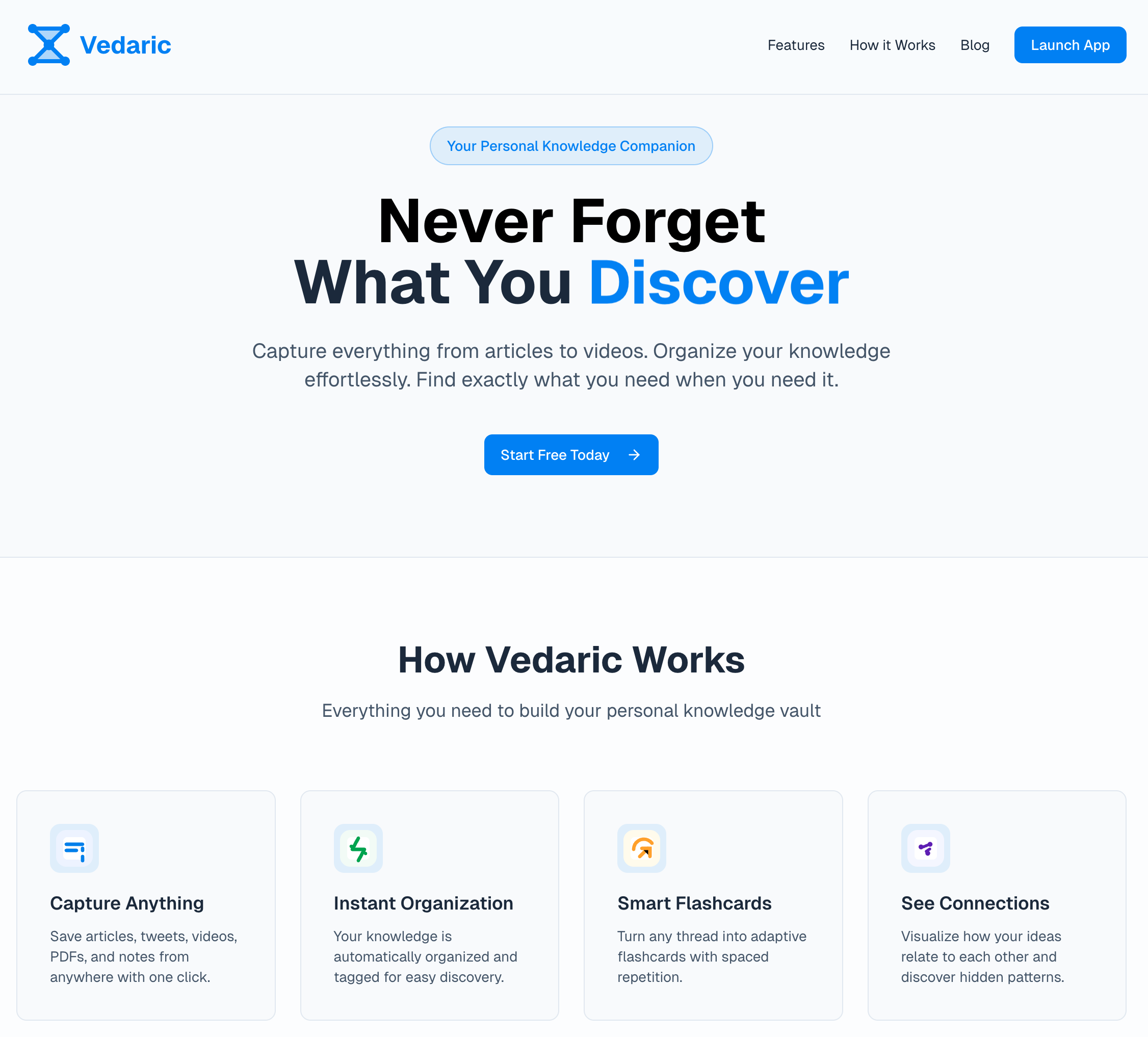
Vedaric bakes these principles into the product: capture funnels, AI summaries, flashcards, knowledge graphs, and conversational retrieval.
- Frictionless capture ensures encoding happens consistently.
- AI-generated prompts and flashcards support elaboration + spacing.
- Evidence-backed answers and graphs show how understanding grows.
Key takeaway
Memory isn't magic—it’s a system. Combine encoding, spacing, elaboration, and retrieval (with AI assistance) to build recall that lasts.